Article Sidebar
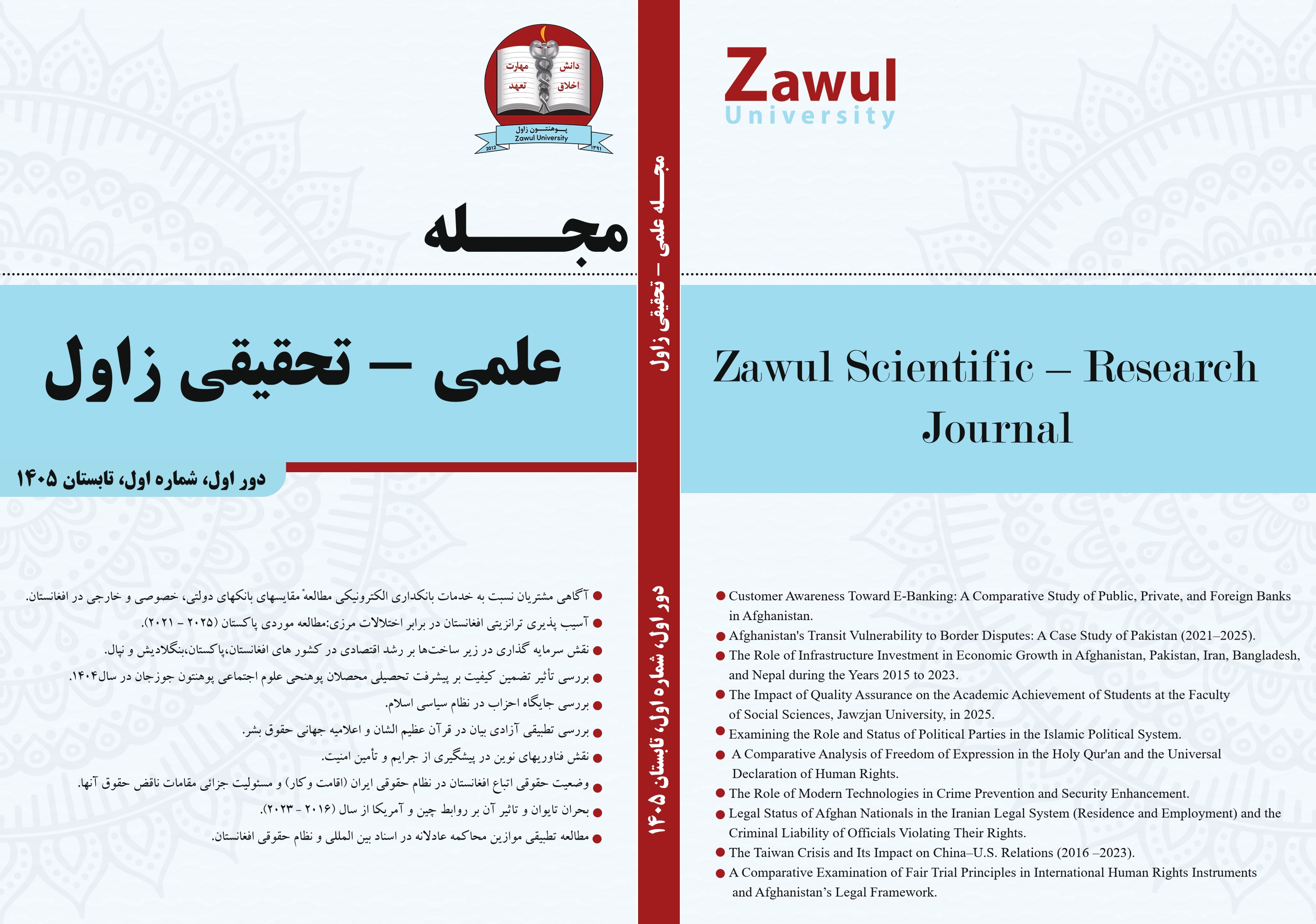
A Comparative Examination of Fair Trial Principles in International Human Rights Instruments and Afghanistan’s Legal Framework
Main Article Content
Abstract
Fair trial standards are considered one of the fundamental principles for ensuring justice, upholding the rule of law, and protecting human rights. These standards occupy a prominent position in both Islamic jurisprudence and the legal system of Afghanistan. This study was conducted with the objectives of identifying the standards of a fair trial in Islamic jurisprudence and statutory law, examining the extent of their implementation in Afghan courts, clarifying the similarities and differences between these two legal systems, and understanding whether these standards are mandatory or discretionary in nature. The research employed a descriptive-analytical methodology and relied on a review of authoritative books, scholarly articles, and academic journals. The findings indicate that Islamic jurisprudence, through its emphasis on judicial independence and impartiality, transparency, the defendant’s right to defense, and equality between litigating parties, provides a comprehensive framework for conducting fair trials and promoting social justice. Although Afghan laws, inspired by Islamic Sharia and international legal instruments, have incorporated principles such as the right to legal counsel and the presumption of innocence, practical challenges remain in achieving their full implementation. The study concludes that the effective utilization of the principles and capacities of Islamic jurisprudence, together with their adaptation to contemporary needs, can serve as a valuable source for improving the judicial system, reducing discrimination, and enhancing public confidence in judicial and legal institutions.
Keywords
Article Details
How to Cite
Similar Articles
- Sakhi Nazari, Teaching Asst. Hedayatullah Azimi, Legal Status of Afghan Nationals in the Iranian Legal System (Residence and Employment) and the Criminal Liability of Officials Violating Their Rights , Zawul Scientific Research Journal: Vol. 1 No. 1 (0): Zawul Scientific-Research Journal, Volume 1, Issue 1, Summer 1404 SH
- Teaching Assistant Abdul Mannan Kurani, Examining the Position of Political Parties in the Islamic Political System , Zawul Scientific Research Journal: Vol. 1 No. 1 (0): Zawul Scientific-Research Journal, Volume 1, Issue 1, Summer 1404 SH
- S. Teaching Asst. Obaidulla Hamid, Samim Serat, The Role of Modern Technologies in Crime Prevention and Security Enhancement , Zawul Scientific Research Journal: Vol. 1 No. 1 (0): Zawul Scientific-Research Journal, Volume 1, Issue 1, Summer 1404 SH
You may also start an advanced similarity search for this article.